Young Researcher and Innovator Conference Grant
LLM-Driven Algorithm Discovery and Tuning
Niki van Stein, LIACS, Leiden University, Leiden, Netherlands
Elena Raponi, LIACS, Leiden University, Leiden, Netherlands
Anna V. Kononova, LIACS, Leiden University, Leiden, Netherlands
Adam Viktorin, Tomas Bata University, Zlin, Czechia
Tomas Kadavy, Tomas Bata University, Zlin, Czechia
Roman Senkerik, Tomas Bata University, Zlin, Czechia
Thomas Bäck, LIACS, Leiden University, Leiden, Netherlands
AutoML 25 International Conference on Automated Machine Learning
New York City, United States
8-11 September 2025
Grantee: Tomas Kadavy, Tomas Bata University, Zlin, Czechia
Type of publication: Tutorial
Type of presentation: Oral
Start date: 2025-09-07
End date: 2025-09-12
Awarded: 2025-07-25
Report approved: 2025-10-31
Abstract
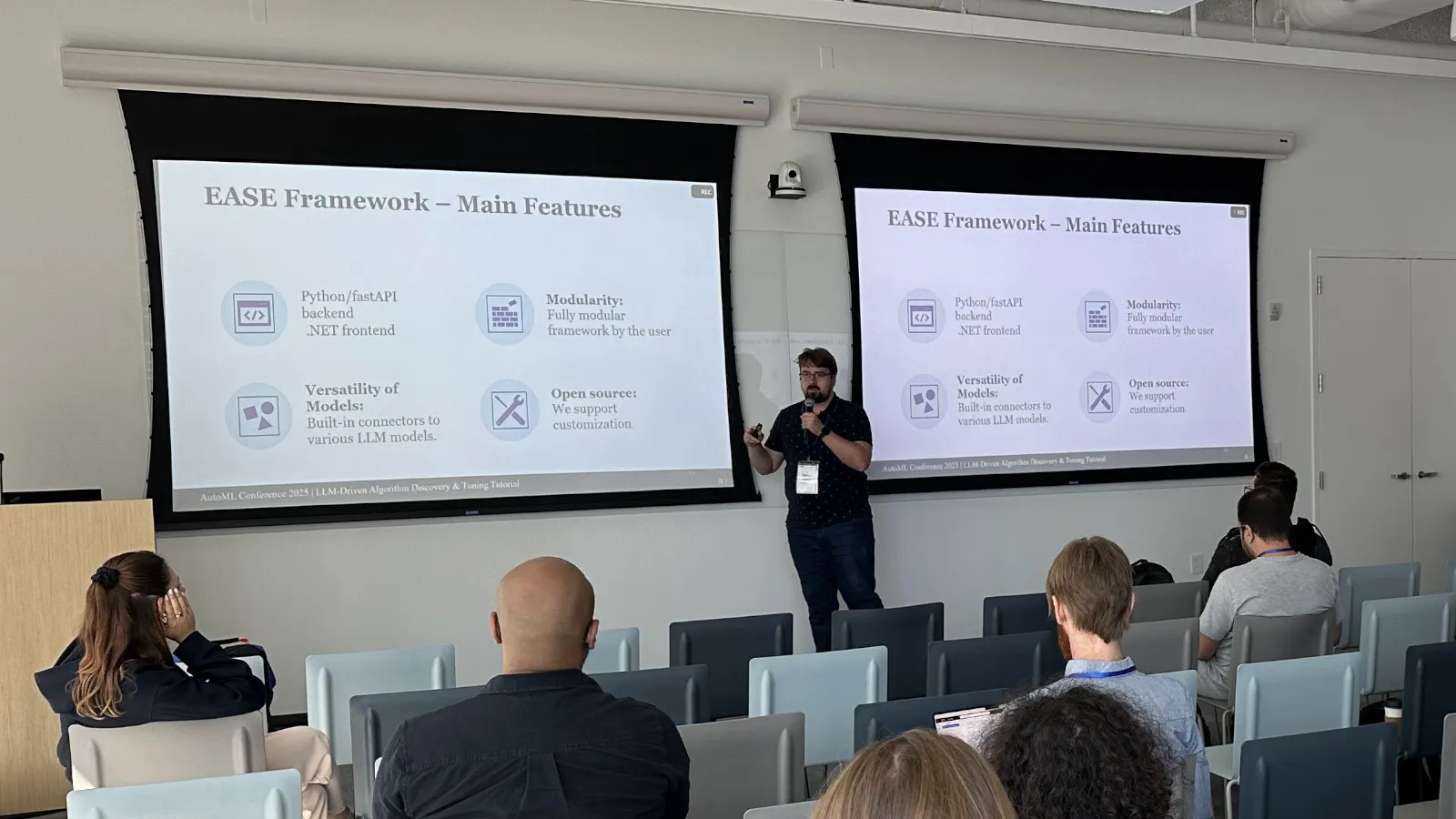
Large language models (LLMs) are rapidly transforming automated machine learning from the level of hyper-parameter tuning to the automated invention of entirely new algorithms, models or even complex machine learning pipelines. In the past 2 years, we have witnessed Fun-Search discovering cap-set proofs, Evolution of Heuristics (EoH) and ReEvo evolving high-performance heuristics, and, more recently, LLaMEA, EASE, and AlphaEvolve discovering and optimizing entire algorithms. The group of Leiden University has contributed LLaMEA, a lean evolutionary framework that couples LLMs with IOHprofiler to generate competitive black-box optimisers, LLaMEA-HPO, which fuses LLaMEA with SMAC to separate creative code generation from numerical parameter search, BLADE, a benchmarking platform to fairly evaluate different LLM-driven algorithm discovery methods, and LLaMEA-BO, an extension of LLaMEA for the automated generation of Bayesian optimization algorithms. The group from Tomas Bata University has contributed to this rapidly emerging field by introducing the EASE, an open-source, modular framework for automating the creation and refinement of solutions—algorithms, code, text, or images—driven by LLMs or other generators.
This 90-minute tutorial equips AutoML researchers and practitioners with (i) a conceptual map of LLM-based algorithm-design paradigms, (ii) hands-on guidance for building, benchmarking and hardening such pipelines, and (iii) an open discussion of challenges in safety, efficiency and evaluation. Attendees will leave with runnable notebooks, updated knowledge on the state-of-the-art in automated algorithm discovery and an appreciation of where algorithm discovery fits in the broader AutoML ecosystem.