Inclusiveness Target Country Conference Grant
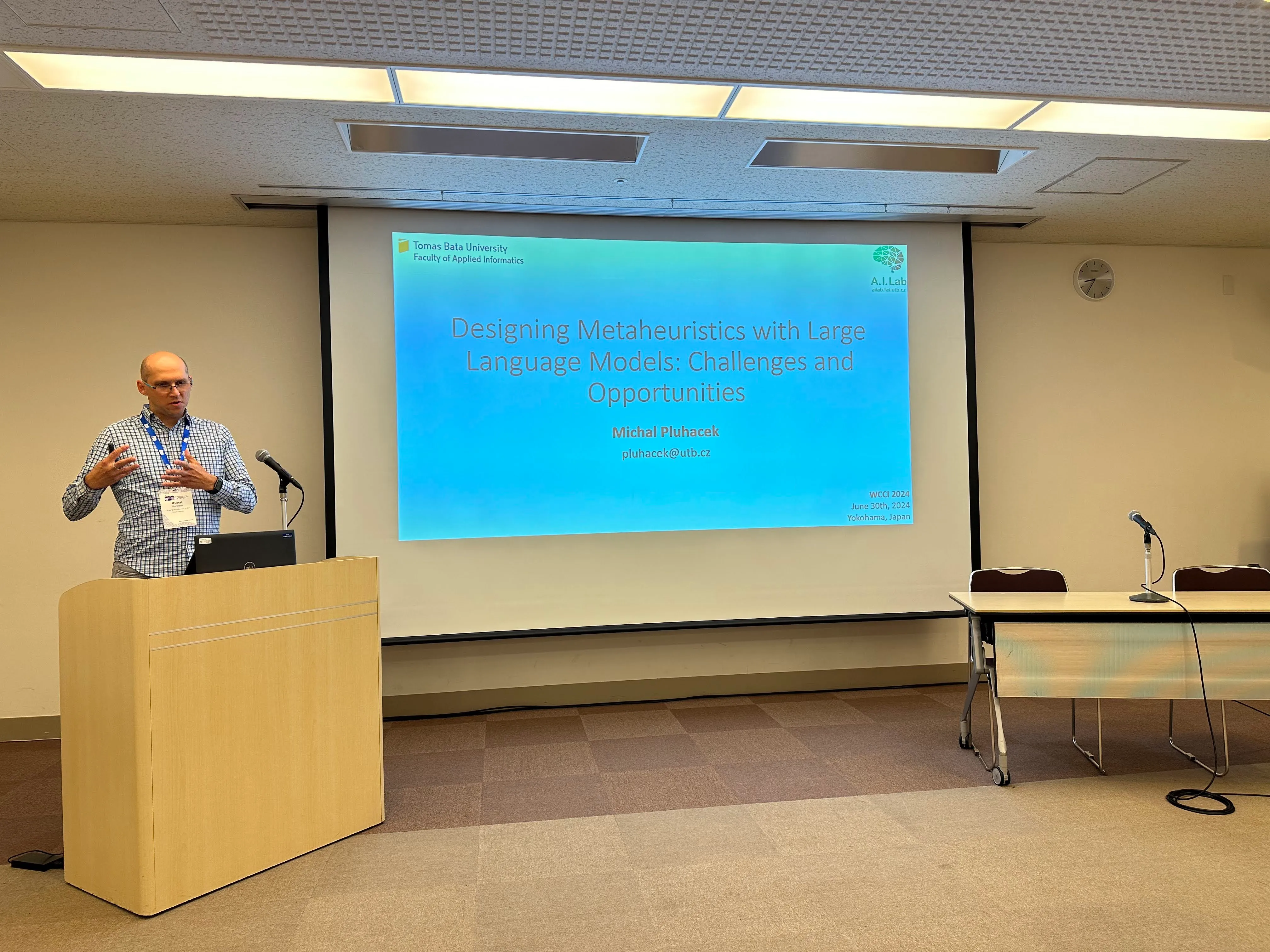
Designing Metaheuristics with Large Language Models: Challenges and Opportunities
Michal Pluhacek, Tomas Bata University, Zlin, Czechia
Adam Viktorin, Tomas Bata University, Zlin, Czechia
Roman Senkerik, Tomas Bata University, Zlin, Czechia
The IEEE World Congress on Computational Intelligence (IEEE WCCI 2024)
Yokohama, Japan
30 June - 5 July 2024
Grantee: Michal Pluhacek, Tomas Bata University, Zlin, Czechia
Type of publication: Tutorial abstract
Type of presentation: Oral
Start date: 2024-06-27
End date: 2024-07-08
Awarded: 2024-06-19
Report approved: 2024-08-10
Abstract
This tutorial will explore the possibilities of utilizing Large Language Models (LLMs) like GPT-4 for designing metaheuristic algorithms tailored to specific optimization problems. The central theme of the talk revolves around a systematic approach to leveraging LLMs’ capabilities in this innovative context.
Workflow and Analysis Process:
Proposing New Algorithms: We will start by prompting the model to propose new metaheuristic algorithms for predefined optimization problems. This will involve inputting detailed problem specifications into the LLM and analyzing the metaheuristic solutions it generates.
Logical and Correctness Evaluation: Each of the proposed algorithms will be meticulously analyzed for their logical structure and correctness. This stage is crucial in assessing whether the solutions provided by LLMs are not only innovative but also logically sound and applicable to the problem at hand.
Viability Assessment: The focus will then shift to evaluating the viability of these proposed algorithms. We will discuss and criticise the practicality of implementing the model output, considering factors such as computational efficiency, scalability, and adaptability to real-world scenarios.
Potential for Novel and Powerful Metaheuristics: A key aspect of the talk will be to determine if LLM’s involvement can lead to the development of novel and more powerful metaheuristic algorithms. We will explore whether the LLM contributions can transcend conventional approaches, offering new perspectives and solutions in the field of metaheuristics.
Conclusion and Future Outlook:
The session will conclude with reflections on the broader implications of integrating LLMs like GPT-4 in metaheuristic development. We’ll discuss the potential future directions this research could take and how it might shape the evolution of algorithmic problem-solving in various domains.
Publication
Pluhacek, M., Viktorin, A., & Senkerik, R. (2024). Designing metaheuristics with large language models: Challenges and opportunities. The IEEE World Congress on Computational Intelligence (IEEE WCCI 2024), 105.Bibtex
@inproceedings{Pluhacek2024Designing,
	address = {Yokohama, Japan},
	author = {Pluhacek, Michal and Viktorin, Adam and Senkerik, Roman},
	booktitle = {The {IEEE} world congress on computational intelligence ({IEEE} {WCCI} 2024)},
	year = {2024},
	month = {6},
	note = {Tutorial},
	pages = {105},
	title = {Designing metaheuristics with large language models: Challenges and opportunities},
}